cLICK HERE TO Check out Our YOutube Channel

Who Is The Real Mother
Put your observation skills to the ultimate test! Look closely at the hidden clues—can you figure out who the real mother is? Click to reveal the answer!
RIDDLES AND BRAIN TEASER
Daily Puzzle Hubz
5/12/20263 min read
Can You Spot the Real Mother? Most Adults Get This Wrong
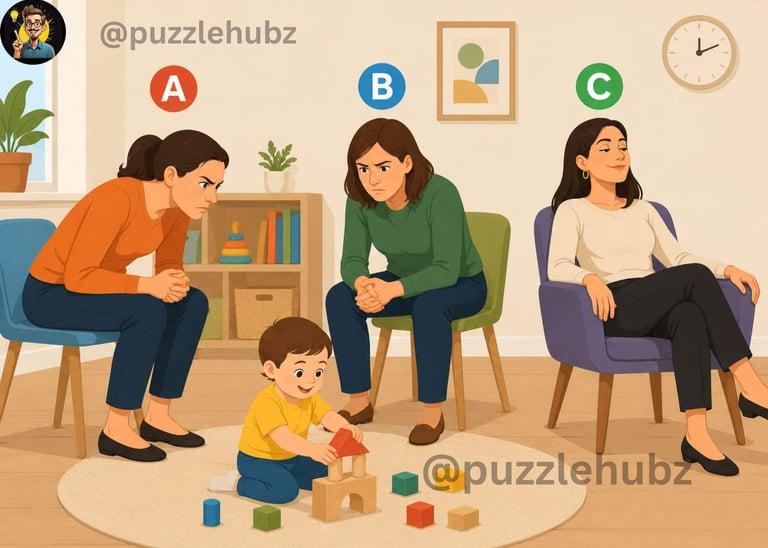
Here's a question that sounds easy until you actually try to answer it: which one of these three women is the real mother?
There's a child in the image. There are three women. One of them is the biological mother. The other two are not. You have to look at the scene — the body language, the positioning, the subtle cues — and make the call.
People who get this right tend to feel smug about it. People who get it wrong feel genuinely rattled, because the answer reveals something about how your brain reads human relationships — and what your instincts say about you.
This riddle has gone viral multiple times for a reason. It's not just a puzzle. It's a mirror. Ready to see what you're working with?
The Rules — How to Play
One image. Three women. One child. Your job is to identify the real mother.
Look at the image carefully before you read anything below it. Don't rush. Study the body language of each woman — where she's facing, how she's positioned relative to the child, what she's doing with her hands. The answer isn't random. There's genuine psychological logic behind it.
Give yourself 30–60 seconds to form your answer before scrolling to the reveal. The explanation will tell you not just who the real mother is, but why — and what picking each answer says about the way you think.
The Riddle
Three women sit in a room with a child playing on the floor. They look similar in many ways. But only one of them is the real mother. Which one is she?
Locked in your answer? Good. Here's the truth.
What Your Answer Says About You
If you picked the woman staring most directly at the child — you're trusting conscious signals over subconscious ones. You assumed that intense attention equals strong attachment. That's the most common answer, and it's wrong for a reason: people perform connection differently than they live it.
If you picked the woman turned away — your brain read the subtler social cue. Secure attachment doesn't need to announce itself. Real maternal confidence looks relaxed, not watchful.
If you picked the middle option — you went with symmetry and positioning as your guide. That's a spatial reasoning instinct rather than a social one, and it says something interesting about how you process human relationships versus spatial patterns.
None of these says you're a bad person. They say something about which cognitive lens you defaulted to under pressure — and that's genuinely worth knowing.
The Science Behind It
Why is this riddle so hard — and why does getting it wrong sting a little?
The core issue is cognitive bias, specifically social desirability bias. When you look at the image, you don't just analyze the data neutrally. You make assumptions about what a "good mother" should look like — attentive, focused, child-facing — and you scan for the woman who best fits that template. The problem is that real behavior doesn't always match the performed version of that behavior.
Pattern recognition is also working against you here. Your brain has seen thousands of images of mothers with children — in ads, in TV shows, in social media. Those images tend to show a very specific visual template: a woman leaning in, eyes on the child, body angled toward them. Your brain matches the women in this riddle against that learned template, and it picks the closest match. But this riddle is specifically designed to break that template.
Lateral thinking is required to get it right. Instead of asking "which woman looks most like a mother," the correct move is to ask "which woman's behavior would make sense for someone who has nothing to prove?" That's a completely different question — and making that shift in real time, under no pressure, is surprisingly hard.
Working memory plays in too: you're holding the identity of three women, tracking their positions, reading their body language, and forming a judgment simultaneously. That's a lot of live information, and under that load, most brains fall back on the most salient visual cue — which is exactly the one this riddle weaponizes.
Finally, insight problem-solving is what the correct answer requires. It's not a calculation or a logical deduction — it's a reframe. The moment you stop asking "who looks like a mother" and start asking "who acts like someone who already knows she's the mother," the answer becomes clear. That shift is the whole puzzle.
Ready for Another One?
You just got outsmarted by body language — and now you know why. Riddles like this one work because they exploit the gap between how we think people behave and how they actually do. There are more of these coming, each one sneakier than the last. See if you can stay one step ahead.
Help
Questions? Reach out anytime, we’re here.
join us for daily fun booster
© 2024. Daily Puzzle Hubz.