cLICK HERE TO Check out Our YOutube Channel

This Color Illusion Will Make You Distrust Your Own Eyes Forever
Prepare to question reality! This mind-bending color illusion will completely trick your vision. Click here to experience it and discover how it works!
PUZZLES & ILLUSION
DAILY PUZZLE HUBZ
5/24/20263 min read
This Color Illusion Will Make You Distrust Your Own Eyes Forever
Your eyes are lying to you right now. Not metaphorically — literally, physiologically lying.
The Adelson Checker-Shadow illusion is one of the most jaw-dropping color illusions ever created, and the wild part? Even after someone explains exactly how it works, your brain still refuses to see the truth. That's not a flaw. That's your visual system doing something genuinely extraordinary — just at the wrong moment.
You're about to stare at two squares and insist they're different colors. They are not. And no matter how many times you're told that, your brain won't fully accept it.
Still think you can see through it? Let's go.
How This Works — What You Need to Do
This one is simple. There's one image. One illusion. Your job is to look at it and answer one question.
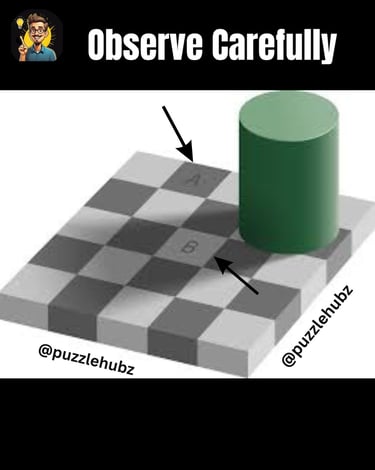
Look at the image below. Find square A and square B — they'll be labeled.
Decide: are they the same color or different colors?
Commit to your answer before you scroll to the reveal.
No timer needed here — take as long as you want. It won't help. That's the whole point of this illusion. Time and effort are both irrelevant when your visual cortex has already made the call without asking you.
The Adelson Checker-Shadow Illusion
This is the one that broke the internet before "breaking the internet" was even a phrase. MIT professor Edward Adelson created it in 1995, and it has been humbling overconfident people ever since.
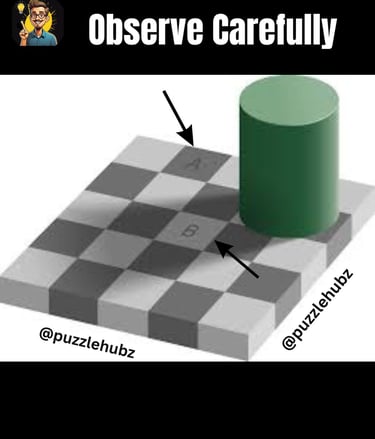
Look at the checkerboard below. Square A sits in the light portion of the board. Square B sits in the shadow cast by the cylinder. The question is simple: which square is darker?
Go ahead. Look hard. Trust your gut.
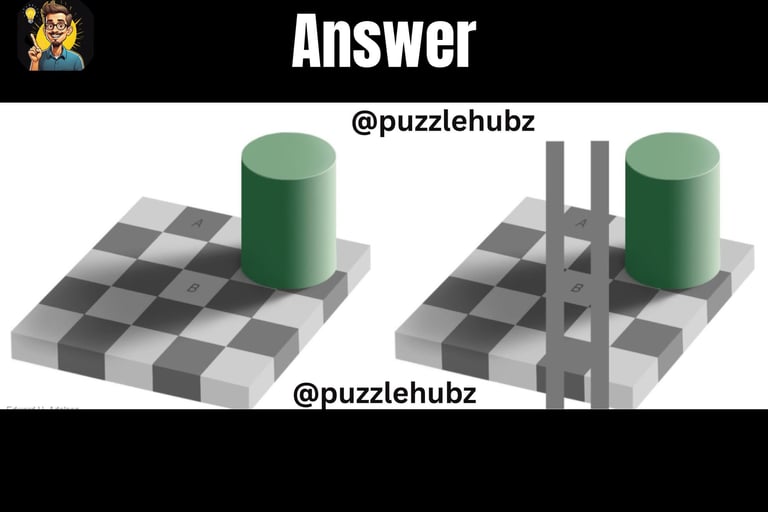
ANSWER:
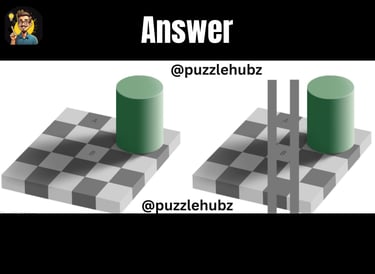
Squares A and B are the exact same shade of grey. If you place a finger or strip of paper over the surrounding squares to block context, the two tiles become visually identical. Your brain interprets square B as lighter because it "knows" squares in shadow receive less light — so it compensates automatically, making B appear brighter than it physically is.]
The Science Behind It — Your Brain Is Correcting Reality in Real Time
Here's where things get genuinely fascinating — and a little unsettling.
The reason this illusion destroys you is a process called color constancy. Your visual system doesn't just passively record light levels like a camera would. It actively interprets them. When you're standing in a forest and a cloud passes over the sun, the actual light wavelengths bouncing off objects change dramatically — but you still perceive a red apple as red. That's color constancy at work. Your brain adjusts for lighting conditions automatically, so objects appear stable even as illumination shifts.
The Adelson illusion hijacks this exact mechanism. Your brain detects the shadow from the cylinder, applies its built-in lighting correction to everything inside that shadow, and decides square B must be lighter than it physically measures — because logically, shadow-covered surfaces need a compensation boost.
This is top-down processing in its rawest form. Top-down processing means your brain uses stored knowledge, context, and expectation to override raw sensory data. You aren't just seeing — you're interpreting. The visual context of a checkerboard pattern adds another layer: your brain "knows" that checkerboards alternate between light and dark tiles, so it leans on that stored pattern when labeling each square.
What makes it extra cruel is lateral inhibition — the way neurons in your visual cortex communicate with their neighbors to enhance contrast at edges and boundaries. Squares surrounded by darker neighbors appear lighter. Squares surrounded by lighter neighbors appear darker. Square B is ringed by shadow, making it pop. Square A is surrounded by brighter tiles, making it appear to recede.
Finally, there's the sheer weight of perceptual ambiguity — the moment when your eyes are receiving genuinely conflicting signals and the brain has to make a call. It always bets on the most statistically probable interpretation from real-world experience. And in the real world, a square sitting in shadow almost always IS lighter than a square sitting in direct light.
Your brain isn't wrong. It's just playing the odds. And this time, the illusion cheats.
Ready for Another One?
Your visual system just got outplayed by a checkerboard and a cylinder — and that's honestly kind of impressive when you understand the neuroscience. Color illusions like this one are some of the sharpest tools we have for studying how perception actually works, and we're just getting warmed up.
The next illusion on this blog hits differently — same principle, completely different execution, and somehow even harder to shake.
Help
Questions? Reach out anytime, we’re here.
join us for daily fun booster
© 2024. Daily Puzzle Hubz.