cLICK HERE TO Check out Our YOutube Channel

The Negative Afterimage Illusion That Will Rewire Your Eyes
Experience the mind-blowing power of negative afterimages. Stare at the center and watch the colors change right before your eyes. Click to start the illusion and see how it works!
PUZZLES & ILLUSION
DAILY PUZZLE HUBZ
6/3/20263 min read
The Negative Afterimage Illusion That Will Rewire Your Eyes
Your eyes are lying to you right now. Not in a metaphorical way — literally, physiologically, provably lying.
Stare at the right image for long enough, look away, and you'll see something that isn't there. A ghost image. In the wrong colors. On a blank white wall. And the wildest part? Your brain won't be able to stop it from happening even if you know exactly how it works.
That's the negative afterimage illusion — one of the most jaw-dropping tricks your visual system plays on you, and one that scientists have understood for centuries but that still manages to floor people every single time they try it.
You don't need special glasses. You don't need a dark room. You just need to follow the instructions below — and then prepare to feel genuinely unsettled by your own eyeballs. Let's get into it.
The Rules — How to Play
This one is simple, but you have to follow the steps exactly or it won't work.
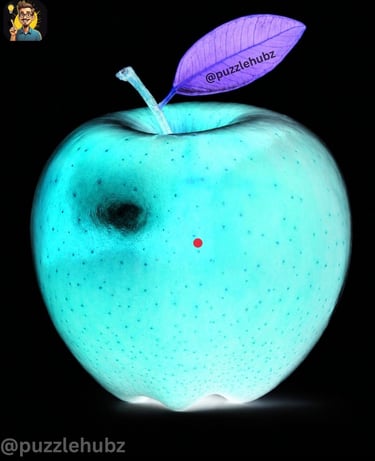
Find the image below — a brightly colored apple with a tiny dot in the center.
Stare directly at the tiny dot without blinking or moving your eyes. Hold your gaze steady for a full 30 seconds. Set a timer — don't guess.
After 30 seconds, immediately shift your eyes to a blank white surface — a white wall, a white sheet of paper, or even a white area of this page.
Blink once, and watch what appears.
You should see a ghostly version of the shape — but in completely different, inverted colors. That's not your imagination. That's your visual system doing exactly what it's supposed to do, just in a way you weren't expecting.
Don't blink during the 30-second stare. Don't look around. The effect only works if you hold your gaze absolutely steady. Think you can do it?
The Illusion
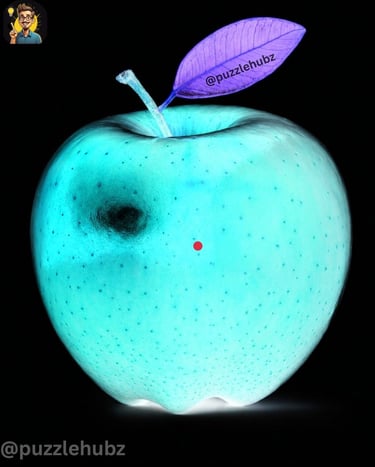
Look at the center of the image. Don't look away. Don't blink. Start your 30 seconds now.
Now look at something white or your wall or ceiling . Blink for 5 to 7 secs.
The Answer Reveal
If you held your eyes still, you just saw a perfectly colored, photorealistic Red Apple with a Green leaf appear on your blank wall! Here is why: the image you stared at was Cyan (neon blue) and Magenta (purple). Because you stared so long, the photoreceptors in your eyes that detect blue and purple got exhausted. When you looked at a white wall, your tired eyes overcompensated by firing the exact opposite colors on the light spectrum — Red and Green. Your brain took those colors, recognized the shape, and projected a perfect "normal" Apple onto the wall!
The Science Behind It What just happened to your eyes — and why does it work every single time?
It all starts with the afterimage effect itself. Your eyes contain three types of cone cells, each sensitive to a different range of light: red, green, and blue. When you stare at a single color for an extended period, the cone cells responding to that color get fatigued — they essentially get tired from constant firing and start to underperform. When you look at a white surface (which reflects all colors equally), the tired cones respond weakly while the fresh, rested cones fire strongly. Your brain reads that imbalance as the opposite, or complementary, color. The result is the ghost image — vivid, unexpected, and completely real.
This is closely tied to lateral inhibition — a process where active neurons suppress the activity of neighboring neurons. In your retina, when one set of color-sensitive cells dominates for a long time, they actively dampen the sensitivity of the opposing color channels. That suppression becomes visible the moment you shift your gaze.
Top-down processing also plays a role here. Your brain doesn't passively receive visual information — it actively interprets it based on expectations and context. When the afterimage appears on a blank wall, your brain tries to make sense of it. It fills in a shape, assigns it colors, and renders it as real even though there's nothing actually there. That's top-down processing at work: expectation shaping perception.
Perceptual ambiguity kicks in when the afterimage starts to fade. Your brain can't quite decide if it's seeing something or not — the image flickers at the edge of perception. This is the visual system caught between two competing interpretations of the same sensory data.
The afterimage illusion isn't a glitch. It's proof that what you see is always a construction — your brain's best guess at reality, assembled from imperfect, constantly adapting biological hardware.
Ready for Another One?
You just watched your own eyes generate a color that wasn't there — and that's only the beginning of what optical illusions can do. Every illusion on this blog is a different window into how your visual system actually works. The next one takes it even further. You're going to want to see it.
Help
Questions? Reach out anytime, we’re here.
join us for daily fun booster
© 2024. Daily Puzzle Hubz.