cLICK HERE TO Check out Our YOutube Channel

Cafe Wall Illusion: Are the Lines Straight? | Daily Puzzle Hubz
Do you trust your eyes? Experience the famous Cafe Wall illusion where perfectly straight lines appear completely bent. Click here to see how this visual trick works!
PUZZLES & ILLUSION
Daily Puzzle Hubz
5/14/20264 min read
These Lines Are Perfectly Straight and Your Brain Refuses to Believe It
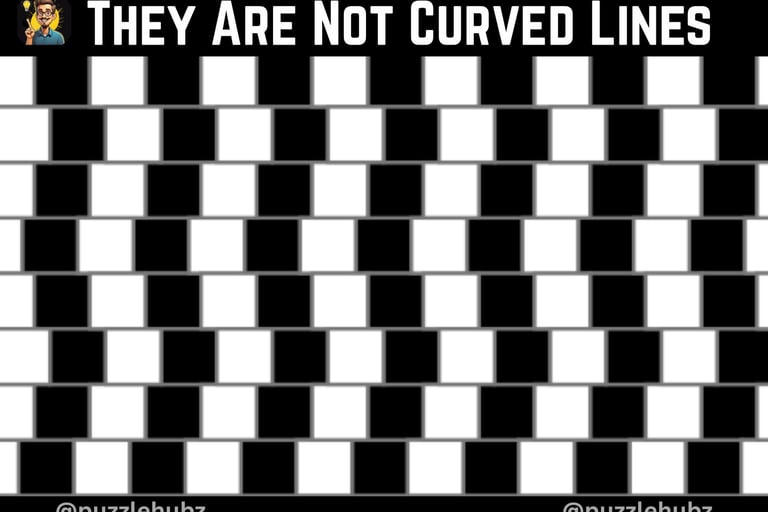
They're not curved. They're not tilted. They're not bending toward each other or fanning apart. Every single line in this image is geometrically, measurably, provably straight — and parallel.
Your brain is about to disagree with all of that, loudly and confidently, the moment you look at the image. That's not a glitch in your perception. That's your visual system doing exactly what it was built to do — and getting it spectacularly wrong in this specific situation.
The Hering illusion and the Café Wall illusion are two of the most studied geometric optical illusions in vision science. They've been pulling the same trick on human eyes for over a century, and the effect hasn't gotten weaker just because we know how it works. You can read this entire post, fully understand the mechanism, look at the image — and still see the distortion. That's how deep it goes.
So here's the setup, here's what to look for, and here's the science that explains what your brain is actually doing when it insists the lines are curved.
The Rules — How to Play
This isn't a timed challenge — it's an observation exercise. There's no "winning." But there is a right way to look at this image, and most people don't do it.
Here's what to do:
Look at the image. Take in the full picture first without focusing on any single part.
Ask yourself: do the horizontal lines look straight, or do they appear to bow, bend, or tilt?
Now grab a ruler — or the straight edge of your phone case — and physically hold it up against the lines on your screen.
Watch what happens to the illusion when the ruler confirms what the lines actually are.
The second step — the ruler test — is the payoff. Most people don't bother with it, and they miss the best part: the moment where you have physical proof in your hand and your brain still refuses to fully update. The distortion stubbornly persists even when you know it's not real. That's what makes this illusion genuinely fascinating rather than just a neat trick.
The Illusion
Look at the lines. Trust nothing your eyes are telling you.
Take a long look. Then get that ruler.
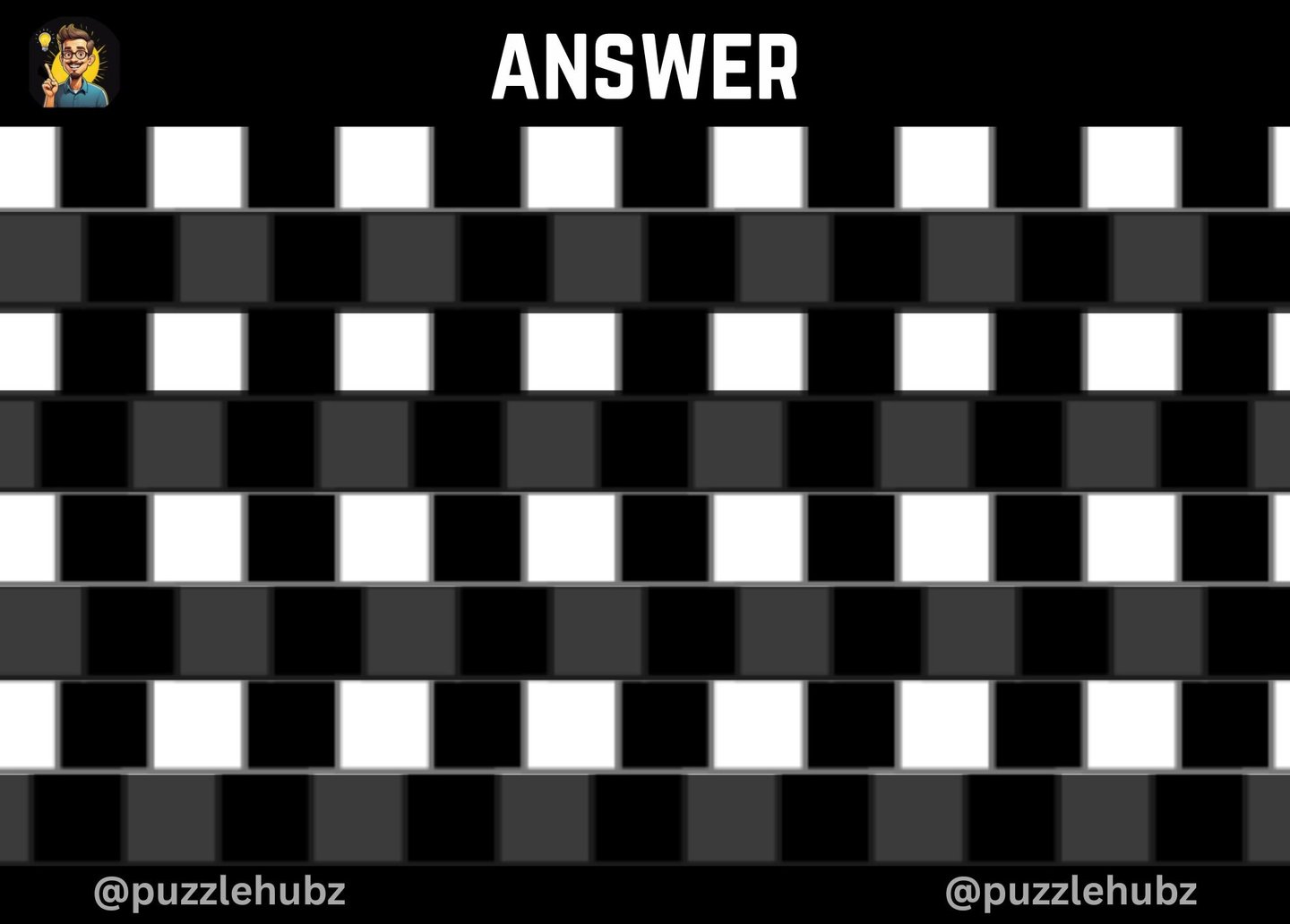
The lines in the image are completely straight and parallel — this should be confirmed with a ruler or straight edge held up to the screen. In the Hering illusion, the straight horizontal lines appear to bow outward in the middle because the radiating diagonal background lines create a false sense of perspective and angular distortion. In the Café Wall illusion, the horizontal mortar lines appear to tilt alternately because the offset placement of alternating dark and light tiles creates edge-contrast signals that override the brain's ability to read the lines as level. Blogger should specify here which version of the illusion the image uses and describe exactly which lines appear distorted and in which direction.
The Science Behind It
What makes this illusion particularly interesting — from a neuroscience standpoint — is that it doesn't fool a camera. Point your phone at that image and the camera sensor will capture perfectly straight lines. It's not the image that's broken. It's the machinery you're using to look at it.
The primary mechanism here is lateral inhibition — and it's one of the more elegant things your visual system does, even when it goes wrong. Neurons in your retina and visual cortex don't just respond to the light hitting them directly. They actively suppress the signals from their neighbors. This creates contrast sharpening — edges look crisper, details pop. It's why you can read fine print and detect subtle shadows. But in a geometric illusion like the Hering or Café Wall, this suppression misfires. The neurons responding to the diagonal or offset background lines bleed into the signals for the straight lines, and the result is a perceived tilt or curve that doesn't exist in the actual image.
Then top-down processing takes over and makes everything worse. Top-down processing is the brain's habit of using existing knowledge and expectations to interpret sensory data before it's fully analyzed. Your brain has seen millions of lines in the real world — railway tracks, roads, hallways — and in almost all of those cases, lines that converge toward a point actually do converge. Lines in a radiating pattern actually do indicate a curve or a surface. Your brain applies that learned rule here, confidently, and gets the answer wrong.
Perceptual ambiguity is what keeps the illusion stuck even after you've measured the lines. The image contains genuinely conflicting signals — the geometric truth of the straight lines, and the distortion triggered by the surrounding context. Your brain can't fully resolve that conflict. It keeps oscillating, seeing what it expects rather than what's there.
This is why knowing how an illusion works doesn't make it stop. Perception happens before conscious reasoning gets involved. The distortion is assembled upstream of your awareness — by the time you "see" anything, the damage is already done.
Ready for Another One?
You just watched your own visual system override provable geometric reality — and that's not something you forget quickly. Optical illusions like this one are windows into the machinery behind every single thing you see, and that machinery is stranger and more fallible than most people ever realize. The next illusion on this blog hits a completely different part of your visual system — and it's going to surprise you just as much. Don't miss it.
Help
Questions? Reach out anytime, we’re here.
join us for daily fun booster
© 2024. Daily Puzzle Hubz.